 Polygonscan
 contract verification: Source Code and ABI
Polygonscan contract verification checks whether submitted source code compiles to the bytecode deployed at a particular Polygon PoS contract address. The process publishes matched source and compilation details for inspection. The contract’s application binary interface (ABI) describes callable functions and their argument types, while the source reveals the implementation that determines behavior.
Reproducing a deployment requires its original build inputs. Constructor values, linked libraries and compiler settings can affect the match. Proxy contracts add another relationship: their callable logic may reside at a separate implementation address.
Source Code Behind a Callable Function
Verified source lets a reader examine the checks inside a callable function, including permissions that its argument fields do not describe. The ABI identifies the function and its typed inputs. The source supplies its body, modifiers and inherited logic. A familiar function name alone does not establish who may call it or which checks it performs. This distinction also applies to token approvals: function signatures describe arguments, while contract code defines how it applies permission changes.
Compiler Settings, Constructor Data and Libraries
A bytecode match depends on reproducing the deployed build, including settings that can change compiler output without changing a contract’s apparent purpose.
Compiler and Optimizer Settings
The compiler version must match the build used for deployment. A compiler that accepts the source may still produce different bytecode from the deployment compiler. Optimizer enablement, optimizer runs and the targeted EVM version also belong to the compilation settings. Advanced options such as
viaIR
require the corresponding Standard JSON configuration. Selecting a compiler default is appropriate only when that default reproduces the deployment build.
Constructor Arguments
Constructor arguments supply deployment-time values, separate from the constructor’s source code. For parameterized constructors, use the original deployment values wherever verification requests an ABI-encoded argument payload. Creation code includes deployment logic; deployed runtime bytecode is the code that remains at the contract address. Comparing only runtime code can leave differences in initialization unresolved.
Linked Libraries and Source Files
Linked libraries need the names and deployed addresses used by the original build. Matching a library’s source while changing its linked address can still change bytecode. Imported files must also resolve to the same source contents. A Standard JSON submission can carry the source tree and compiler settings together. The filename and contract name identify the compilation target when the submitted sources contain several contracts.
Manual Submission, API Calls and Similar Matches
The browser form accepts a manual source submission, while Etherscan API V2 supports automated submission of the same build information. Cross-chain similar matching draws on code already verified elsewhere.
| Verification Route | Requirement or Match Limit |
|---|---|
| Manual Source Submission | Complete source and compilation settings must reproduce the deployment; advanced settings use Standard JSON input. |
| Etherscan API V2 Submission | The request needs an Etherscan API key and the selected chain ID; its GUID identifies a submission. |
| Cross-Chain Similar Match | Previously verified source on another supported explorer can provide a similar match; initialization may differ. |
| Shared Limit | Verification scope follows the reported match, regardless of the submission route. |
Polygon PoS mainnet uses
chainid=137
in V2 requests. Source submissions use
module=contract
and
action=verifysourcecode
; neither parameter identifies the network by itself.
What Does a Verification Match Prove?
Source-code verification reproduces compilation to compare its output with deployed bytecode. An exact match supports the relationship between published code and that particular deployment. A similar match carries a narrower meaning: runtime bytecode can match previously verified code while constructor arguments or initialization differ. Initial values may affect behavior even when deployed code looks identical.
Verification status does not measure the quality of access controls or establish that every callable action is safe. Security review examines code behavior and privileges, including the powers that administrators retain. Current storage also matters when conditions depend on balances, roles or configuration.
Proxy Code and Implementation Changes
Proxy verification connects a proxy address with an implementation, making the distinction between routing code and callable logic visible during inspection.
Proxy and Implementation Addresses
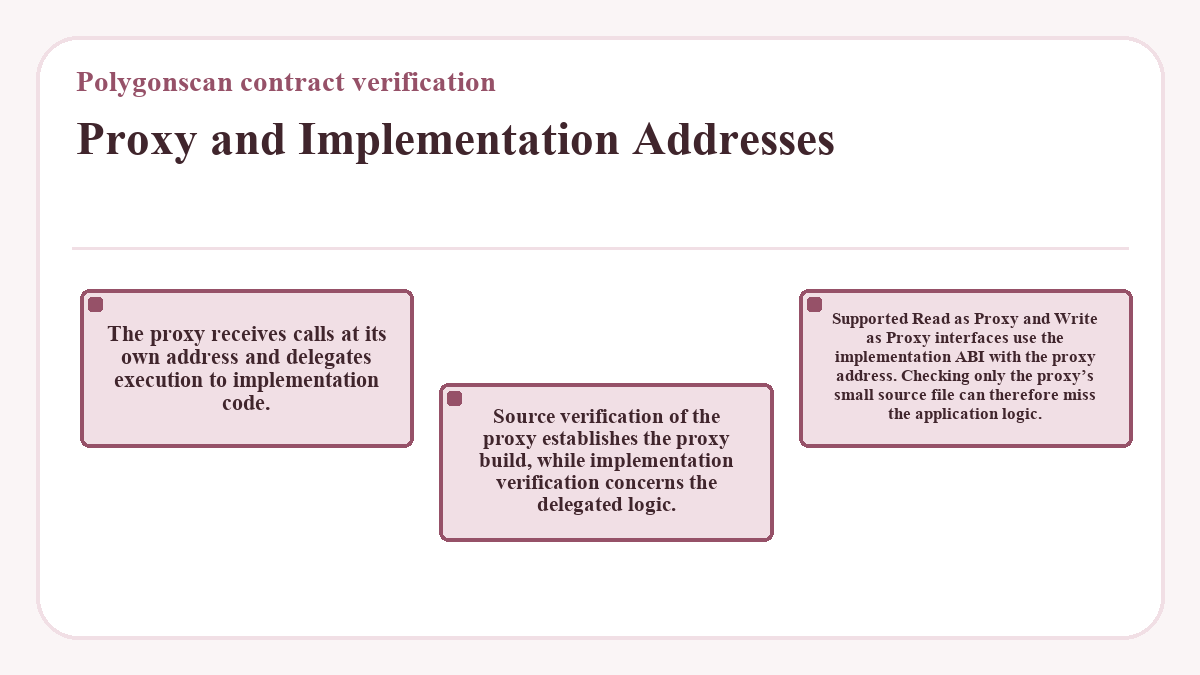
The proxy receives calls at its own address and delegates execution to implementation code. Source verification of the proxy establishes the proxy build, while implementation verification concerns the delegated logic. Supported Read as Proxy and Write as Proxy interfaces use the implementation ABI with the proxy address. Checking only the proxy’s small source file can therefore miss the application logic.
Upgrades and the Active ABI
An upgradeable proxy can retain its address while changing the implementation that handles calls. Verification of an earlier implementation does not verify replacement code. A previously retrieved ABI may no longer describe the replacement. Rerunning proxy verification can refresh the implementation association. Proxy detection does not guarantee that the displayed implementation handles a particular call; the association must agree with the proxy’s actual routing.
Submission Status and Build Mismatches
A verification submission and a completed match are different states, so API automation must read the verification result after submission.
With Etherscan API V2,
verifysourcecode
returns a GUID for the submitted job. The
checkverifystatus
action uses that identifier to report its outcome, including
Pass - Verified
for success. An initial
status
value of
1
with a GUID confirms submission. It does not by itself confirm a bytecode match.
Compilation errors concern the submitted source or its dependencies. A bytecode mismatch means that the reproduced build does not agree with the deployed code. Compiler options, constructor data and linked-library settings are distinct possible causes. A metadata-hash mismatch may require Standard JSON with the original metadata settings. Repeating an unchanged submission cannot correct a different build input.
ABI Retrieval and Its Inspection Limits
ABI retrieval supports call encoding and result interpretation, while source retrieval preserves the code and build details needed for closer inspection. In Etherscan API V2,
getabi
returns the verified contract interface and
getsourcecode
returns source with compilation metadata. The ABI names functions, inputs and outputs. Its event entries identify which parameters are indexed, giving decoders the layout needed to interpret retrieved event logs.
A function entry’s
stateMutability
distinguishes
view
,
pure
,
nonpayable
and
payable
behavior. These labels do not list every runtime precondition. A script can reuse an ABI for encoding while the callable interface remains unchanged. A source review must also account for active settings and any delegated implementation.
Polygonscan contract verification questions worth asking
Does source-code Verification Also Confirm Contract Address Ownership?
Source-code verification and contract address ownership verification establish different things. The source check compares a build with deployed code. Ownership verification links a contract to a Polygonscan account through a signed-message process involving the creating address. A public source-code match alone does not establish that account relationship.
Can I Submit Source Verification Before Deploying the Contract?
Source verification needs contract code at the specified address on the selected network. A contract address from a different network does not satisfy that requirement. A successful deployment may also take time to appear in the explorer’s index, so an unavailable-code response does not always identify a compilation problem.
Are Private and Internal Functions Included in a Verified Contract ABI?
Solidity private and internal functions do not appear as externally callable functions in the contract ABI. Their implementations can still appear in published source. The compiler’s visibility rules control how contracts call these functions; marking a function private does not make its published code or onchain information confidential.
Is a Paid API Plan Required to Retrieve Verified Source Code or an ABI?
Source-code and ABI endpoints are available on every Etherscan API plan, including the Free Tier. Requests still use an Etherscan API key and the chain ID for the contract’s network. This access rule concerns those contract endpoints; it does not grant unrestricted access to all other Polygon PoS data.
Why Can Verification Fail When My Imports Work Locally?
Local compilation can resolve dependencies that the submitted verification input omits. When the verifier cannot retrieve an external import, that submission fails even though the local build succeeds. Flattened source or Standard JSON with embedded dependency contents can resolve the missing input; the remaining build settings still need to reproduce deployment.
What Effect Can comment-only Edits Have During Contract Verification?
A comment-only edit can change compiled bytecode when the build includes the compiler’s metadata hash. Source-file hashes contribute to that metadata, even when an edit leaves executable logic unchanged. Retaining the original source files helps preserve the exact compilation fingerprint; a matching function interface alone cannot establish that fingerprint.